
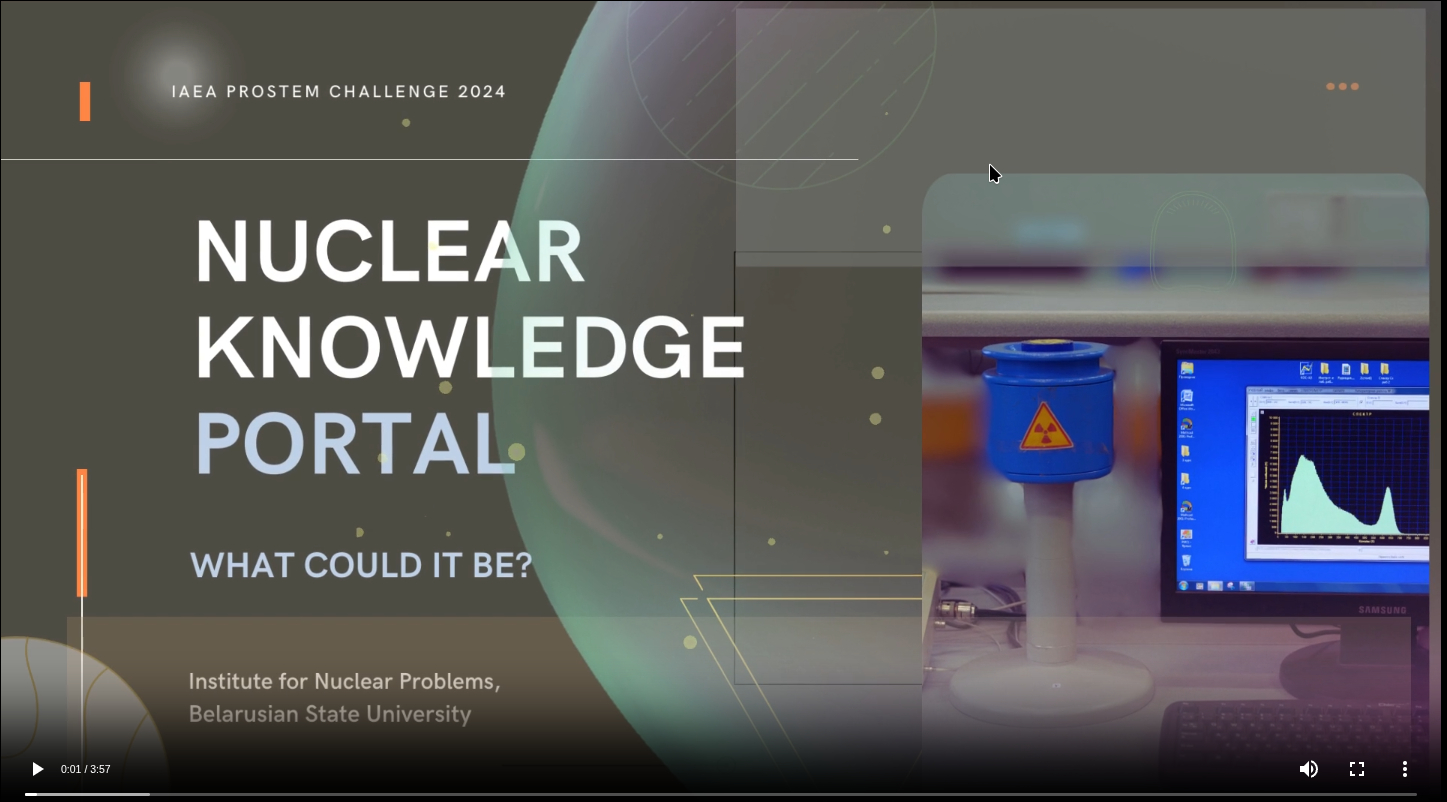
ProSTEM Challenge Project: Nuclear Knowledge Portal
 2026-10-22 12:24:34
With growing global attention to nuclear power, taking into account the expected increase in its capacity, as well as fast development and implementation of advanced nuclear technologies with innovative nuclear reactors and thermonuclear fusion being include the problem of training of highly qualified specialists in the field of fundamental areas and especially in nuclear physics and nuclear engineering becomes increasingly important.
Quite meager ideas about the subject and objects of study of nuclear physics (due to their quantum nature) do not contribute to the choice of relevant specialties. The active and methodologically correct use of the fairly developed phenomenology of nuclear physics, as well as the variety of its directions, partially solves this problem. On the other hand, the above-mentioned specificity of nuclear physics combined with the high speed of the university educational process and its focus on the formation of specific practical skills leads to neglect of the fundamental principles. Ignorance of basic principles, poor understanding of physical processes, laws and physical quantities that describe them definitely do not contribute to the formation of the foundation of scientific thinking as well as to the preservation of knowledge and therefore do not contribute to the development of science and new technologies and do not contribute to achieving sustainable development goals.
An important role in the successful implementation of educational standards and current training programs, various educational initiatives is played by the use of innovative educational technologies, namely electronic learning tools, specialized Internet resources and portals as well as educational platforms and services. However, the diversity and fragmentation of resources together with specific characteristics of each of them ultimately leads to their lack of demand. As a result, priority is given to the use of simple information requests to search engines, neural networks or chat bots, which often provides their users with not completely correct results.
Therefore, it becomes relevant to create an open information and educational resource or nuclear web portal under the direction of a team of highly experienced lecturers and scientists. Such a portal should implement the ability to modify its structure and expand functionality, remote editing and input of educational materials and documents, various sorting and filtering, as well as standard elements of learning management systems.
Combining the role of an web portal as well as functionality of educational and scientific center by providing with selection performed by experts and development of reference dictionaries, glossaries, various educational materials together with online courses and using interactive methods and knowledge assessment tools, providing access to educational, methodological and scientific literature, articles as well as the links to the external Internet resources, databases and libraries, the nuclear knowledge portal will ensure the integration and storage of large volume of selected information in order to attract young talents to the nuclear industry by means of providing them with support during their educational process. The portal will thereby assist with formation of systemic basic knowledge. In addition, the nuclear knowledge portal will provide students with the guidance on selection of highly specialized area of study in nuclear physics as well as with the choice of the field of their scientific or engineering professional activity.
Used sources
https://www.iaea.org/atoms4netzero
https://www.iaea.org/events/nuclear-energy-summit-2024
https://www.un.org/sustainabledevelopment/sustainable-development-goals/
https://pris.iaea.org/pris/home.aspx
https://www-pub.iaea.org/MTCD/Publications/PDF/RDS-1-43_web.pdf
https://www.gen-4.org/gif/jcms/c_9260/public
https://www.youtube.com/watch?v=kQzSWZaeLZ8&t=54s
https://www.youtube.com/watch?v=LptRD6B7UTY
https://www.kfe.re.kr/menu.es?mid=a20202030100
https://www.sciencedirect.com/science/article/pii/S2666675822000650
https://www.tandfonline.com/doi/full/10.1080/15361055.2019.1600931
https://cfs.energy/technology/
https://www.iaea.org/resources/nucleus-information-resources
https://www.iaea.org/online-courses
https://www.iaea.org/online-courses
https://gnssn.iaea.org/main/getr/Pages/default.aspx
https://www.nrc.gov/reading-rm/training.html
https://www.tuvsud.com/en/industries/energy/nuclear-power/training-workshop-tutorials